
Field Note 04 / AI × Markets
Why Bitcoin's Volatility Is Predictable and Its Direction Isn't
Part 2 of a series on what AI can and can't do in markets. Part 1: Why I Stopped Trying to Make AI Predict Bitcoin.
The AI people picture when they ask about predicting Bitcoin already exists, and it already works well. Just not for the half of the question most people actually mean.
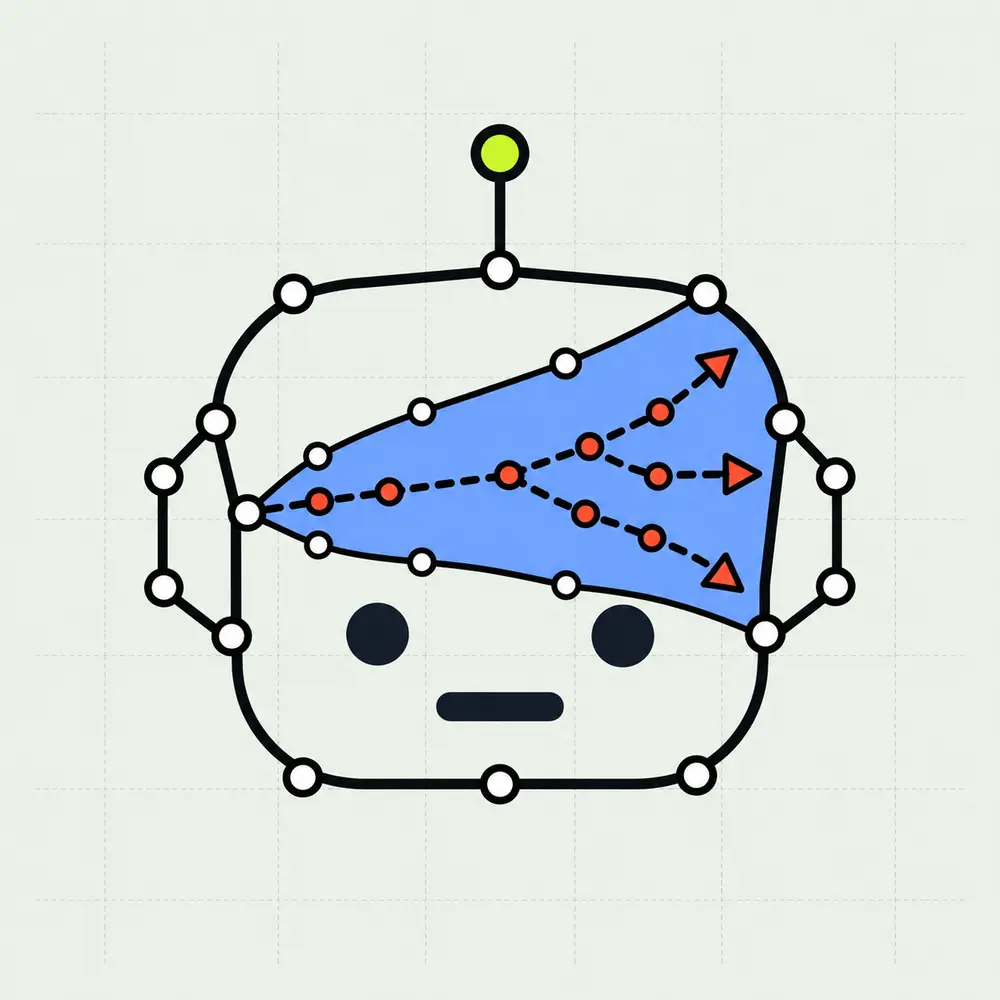
Tomorrow's price forecast splits into two separate quantities: where it goes — direction, or the first moment — and how hard it swings getting there — volatility, or the second moment. Confusing the two is where most of the disappointment comes from.
What is actually predictable
Volatility is one of the more durable findings in finance. It clusters: a violent day is more likely to be followed by another violent day than by a quiet one. The GARCH family of models, realized volatility from intraday data, and implied volatility backed out of options prices all exploit versions of that persistence.
In crypto, part of this forecast is already traded rather than merely modeled. Deribit publishes a BTC volatility index and public option prices across strikes and expirations. Those prices can be used to extract a risk-neutral distribution of future BTC prices. Deribit does not publish a literal real-world probability distribution for tomorrow; the distribution has to be inferred, and it includes the price investors pay for risk. But a hypothetical AI trained to forecast dispersion would still be competing against information the options market continuously prices with money.
Sources: Engle, “Risk and Volatility: Econometric Models and Financial Practice” →; Breeden & Litzenberger, “Prices of State-Contingent Claims Implicit in Option Prices” →; Deribit volatility-index API documentation →.
Why direction mostly isn't
Direction is close to the opposite case, and not because the models are necessarily bad. Expected daily return is tiny relative to daily dispersion: the drift is commonly measured in hundredths of a percent while Bitcoin's daily volatility is measured in percentage points. Even a reasonably estimated mean can disappear inside the variance before trading costs are considered.
There is also a structural asymmetry. A volatility forecast can be useful without identifying whether the buyer or seller of Bitcoin wins tomorrow. Directional forecasts, by contrast, invite immediate competition: if a repeatable signal survives costs, traders act on it and move the price. Volatility itself is tradable through options, so it is not free money. The narrower point is that forecasting the size of a move is usually more stable than forecasting its sign.
The exception that proves the rule
Some firms do earn extraordinary returns from short-horizon directional and relative-value signals. Renaissance's Medallion fund is the obvious example, alongside high-frequency trading firms more broadly. But the public record does not tell us that Medallion simply predicts tomorrow's close. Quantitative trading at that level combines many small signals, portfolio construction, market microstructure, execution, and strict capacity management.
Medallion stopped accepting new outside capital in the 1990s and ultimately became employee-only. That is consistent with the idea that some edges are real but capacity-constrained; it is not proof of exactly where the edge comes from. An edge that cannot scale is still an edge. It just does not show that a larger general-purpose model turns daily direction into an oracle.
Context: Renaissance Technologies →; Financial Times, “Jim Simons, founder of pioneering quant fund Renaissance Technologies, dies” →.
The market is worse than weather
The weather analogy is useful, but imperfect. Weather is chaotic: forecasts lose precision as small errors in initial conditions compound. Markets add another problem. Tomorrow's price depends on information that does not exist yet, on decisions people have not made and news that has not happened. Historical data cannot contain those future shocks.
Markets are also reflexive in a way weather is not. A weather forecast does not change the weather. A widely trusted price forecast changes orders, positions, and therefore the price it is trying to predict. More compute can improve inference from information that exists; it cannot recover information that has not yet been created.
What a maximal AI would actually give you
Run the most capable model available on every available dataset, and the honest output would probably resemble what the options market already expresses: a distribution of possible outcomes, a forecast of dispersion, and perhaps a directional skew that is small, unstable, and potentially smaller than the cost of trading on it. Not zero. Just not the kind of edge worth building an oracle around.
This is the same conclusion Part 1 reached from a different angle, and the same discipline behind every note in Searching for Edge: a result that survives the trip from a good idea to real, costed, out-of-sample execution is rare, and much of what looks like a directional edge is really something else wearing its clothes.
A maximal AI would give you a better distribution, not a crystal ball.