
Field Note 08 / Trading Signals
Why an AI Trading Signal Is Not a Trading Strategy
Binance Skills Hub gives AI agents access to crypto data, signals, wallets, and execution. The difficult question is where a useful signal ends and an executable strategy begins.
This field note explains the central distinction. The complete methodology, all 19 classifications, live checks, token cases, limitations, and code are published in Research Note 08: Binance Skills Hub Audit.
The answer was narrower than the product names suggest. The Hub is useful infrastructure. It can retrieve order books and trades, monitor wallets, surface token rankings, configure on-chain events, and execute operations. But among the 19 skills we inspected, we did not find a complete, reproducible strategy for Binance Spot or Futures.
We started with the code, not the win rate
Each published skill was inspected with four questions in mind: what is actually visible in its files; what remains on a closed Binance backend; whether it contains a trading method or only an interface; and whether its historical result can be evaluated without borrowing information from the future.
We then ran two live laboratories without API keys, wallet permissions, or orders. The first tested the CEX-facing binance skill on public order-book, trade, and liquidation data. The second installed binance-trading-signal, queried its BSC strategy catalogue, and manually checked selected token cases. We also queried crypto-market-rank to see whether its rankings pointed to a different market or methodology.
The CEX skill worked—and proved the distinction
On QKCUSDT, the skill returned a best bid of 0.002704 USDT and a best ask of 0.002710 USDT. That was a midpoint spread of about 22.16 basis points. Walking the displayed ask book implied estimated slippage of 3.53 bps for a 100 USDT market buy, 8.09 bps for 500 USDT, and 13.18 bps for 1,000 USDT. In the latest 100 aggregate trades, aggressive buys represented 35.61% of volume and aggressive sells 64.39%.
Those are useful inputs for execution research. But the calculations were ours. The skill supplied the market data; it did not supply an entry, an exit, position sizing, or evidence that any rule survives fees and slippage. Access to a market is not a method for beating it.
A tool can expose every input a strategy needs without containing the strategy itself.
The apparent strategies lived on a different market
The skills that looked most like finished trading systems were aimed mainly at on-chain activity: Smart Money wallets, BSC meme tokens, launchpads, bonding curves, token migration, and DEX rankings. That is not the CEX universe used by Klines. A threshold learned from a young BSC pool cannot be moved into Binance Futures and treated as the same signal.
binance-trading-signal exposes configurable filters for liquidity, market capitalization, token age, transactions, holder concentration, wallet groups, purchase size, and time windows. But tracked-wallet selection, parts of the scoring, and the server-side backtest engine remain closed. The output includes win rate, maximum gain after a signal, time to peak, and Gold, Silver, or Bronze labels. We could not reproduce from the published files exactly what constitutes a winning trade or an executable exit.
A 90% rise can still describe a bad trade
STONKVIRUS made the problem unusually clear. A Flap Near Grad signal appeared at 0.0000283677. The later maximum shown in the feed was approximately 90% higher. Viewed at that point, it looked like an excellent signal. Later, the observed price was around 89% below the original signal price.
The same chart could therefore support two incompatible stories: a near-doubling or a severely damaged position. Neither is a trading result until the test defines the price and size that could actually be filled, token taxes, slippage, and the exit rule. Maximum price after a signal is a legitimate descriptive statistic. It is not realized return.
“Low risk” did not mean tradable
Nneko, a token I had created while experimenting with the platform, became a useful control case. Its screen showed a market capitalization of roughly 9,440 USDT, an audit label of Low risk, liquidity of only 20.86 USDT, and zero 24-hour trading volume.
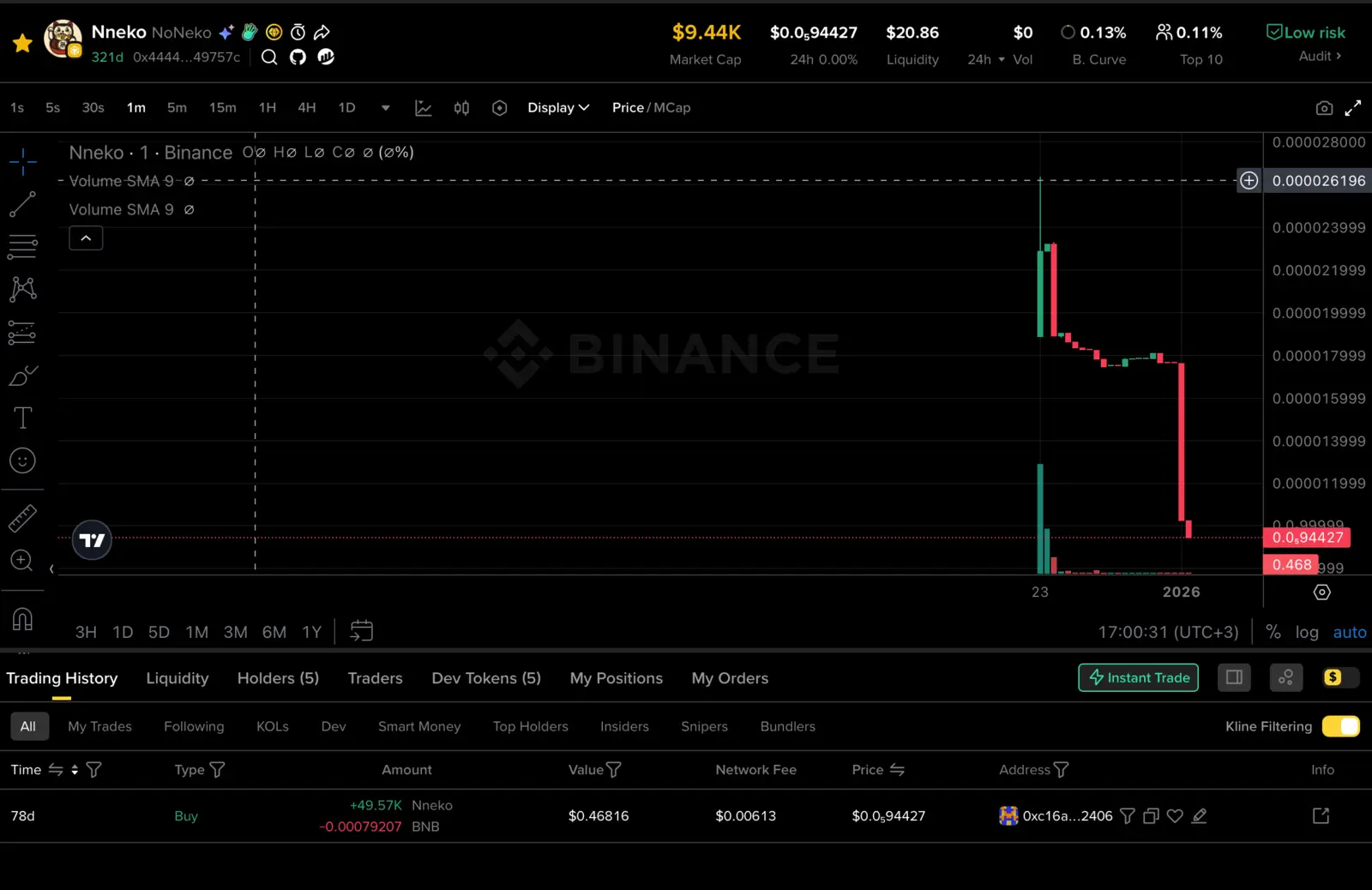
The label may say something useful about the contract checks performed by the interface. It says nothing about market depth, demand, or whether a position can be exited. Market capitalization is not the amount of money available in the pool. Security screening and trading suitability answer different questions.
Why we did not backtest the headline numbers
The installed interface returned no more than 100 signals per source, and we did not obtain a complete paginated history. A valid historical test would also need dead tokens and pools, historical liquidity and volume at the decision timestamp, bonding-curve state, swaps, token taxes, executable depth, and sale restrictions.
Using today's liquidity or holder count to filter an old signal would introduce look-ahead and survivorship bias. Selecting only the charts that later looked impressive would do the same thing informally. The absence of a clean archive was not a reason to improvise a backtest; it was the result of the audit.
We opened the collector, not a performance claim
To test whether forward collection was possible, we wrote a small Python prototype that polls the observed public Binance Web3 endpoint for new, finalizing, and migrated tokens on Flap and Four.meme. It stores complete responses in SQLite and records preliminary Near Grad and Graduate in 10 min events.
One successful run saved 523 rows across 520 contracts and 99 apparent events. Those are not 99 forward signals. On the first run, the collector has no previous state, so tokens already above a threshold appear newly observed. The run proves that the collection mechanism worked at that moment. It does not prove a strategy, a win rate, or even a usable time series.
What survived the audit
- The CEX access layer is useful.It can support market-data collection, execution analysis, and eventually order operations.
- The DEX feeds contain testable events.Bonding-curve progress and migration speed can become hypotheses if collected prospectively.
- The published performance fields are not enough.Maximum gain and platform win rate cannot be treated as executable return without reproducible entry and exit rules.
- The markets must stay separate.On-chain meme-launch signals do not validate a Binance Spot, Futures, or Klines strategy.
- No ready-made CEX edge was found.The useful discovery was the boundary between infrastructure, signal presentation, and a strategy.
The clearest next hypothesis lies outside the Skills Hub we reviewed: official Binance listing announcements. A valid test would have to separate the time Binance published an announcement, the time an observer first received it, and the time Binance trading opened, while measuring where the asset was actually tradable before listing. Until then, “listings go up” is a hypothesis, not a trading rule.
Full methodology and results: Research Note 08 →. Open prototype: collector.py →. Audit target: Binance Skills Hub →.